
Know what happened on every field visit.
Field service fraud prevention for utilities.
What is field service fraud, and how is it prevented?
Field service fraud is field work that is reported but not done as recorded: a bribe to overlook a problem, a falsified inspection, or an inspection closed from a parking lot. It thrives because the company that dispatched the crew sees only the paperwork, never the visit itself.
Prevention starts by making every visit produce its own evidence.
How Fluyenta prevents it
With Fluyenta, the customer’s consent is recorded before capture, the visit is captured on bodycam with GPS coordinates and timestamps, a digital signature closes the work order, and the evidence is sealed so that later alteration is detectable. AI then reviews every visit and scores its fraud risk on a scale of 0 to 100. Visits that score low proceed without intervention; flagged visits reach a supervisor, who decides.
Fluyenta records every visit as sealed evidence, reviews every visit with AI rather than a sample, and leaves the decision on every flagged visit with your people.
Updated October 20, 2026.
Unverified field work is a loss the utility and its customers carry.
14.95%
Colombia’s distribution networks lost 14.95% of the energy entering them in 2023.
USD 9.6 to 16.6billion a year
Electricity losses cost the region’s distributors billions each year.
12months
Fraud typically runs for a year before it is found.
45%
Corruption, which includes bribery, appears in nearly half of fraud cases.
Sources and scope
When a visit produces no verifiable evidence, the record rests on one person’s word, taken where nobody else was watching. The cost of that gap appears as energy lost and unbilled, fraud that runs for months before it is found, and charges borne by paying customers.
- 14.95%. Losses came to 10,802.63 GWh. The Caribbean coast carried 27.52% of the energy but 47.42% of the losses (UTP for CREG, 2025).
- USD 9.6 to 16.6 billion a year. Distribution companies in Latin America and the Caribbean lose between USD 9.6 and 16.6 billion a year to electricity losses, and fraud “in collusion with the operators” is among the causes (IDB, 2024).
- 12 months. Across 2,402 occupational fraud cases, the median scheme lasted 12 months before detection (ACFE, 2026).
- 45%. Corruption, the category that includes bribery, appeared in 45% of occupational fraud cases, with a median loss of USD 150,000 (ACFE, 2026).
Colombia’s regulators publish total losses, not the share caused by theft or fraud. A sampling audit can estimate how common problems are, but it examines only the visits it selects, so fraud in a visit that is not selected goes unseen.
Notes on scopeThree patterns of field fraud, and the evidence that exposes each.
Field service and inspection fraud in utility operations takes three recurring forms. Each succeeds for the same reason: nobody from the utility is there to see the work itself.

The visit that did not take place as reported.
How the missing visit is exposed
- What happens
- The inspection is closed from a parking lot, rushed or never carried out, and the report is completed regardless. Where recording is optional, the obvious course is not to record.
- Exposed by
- GPS coordinates, timestamps, and the risk score, which treats missing evidence as a signal in its own right.
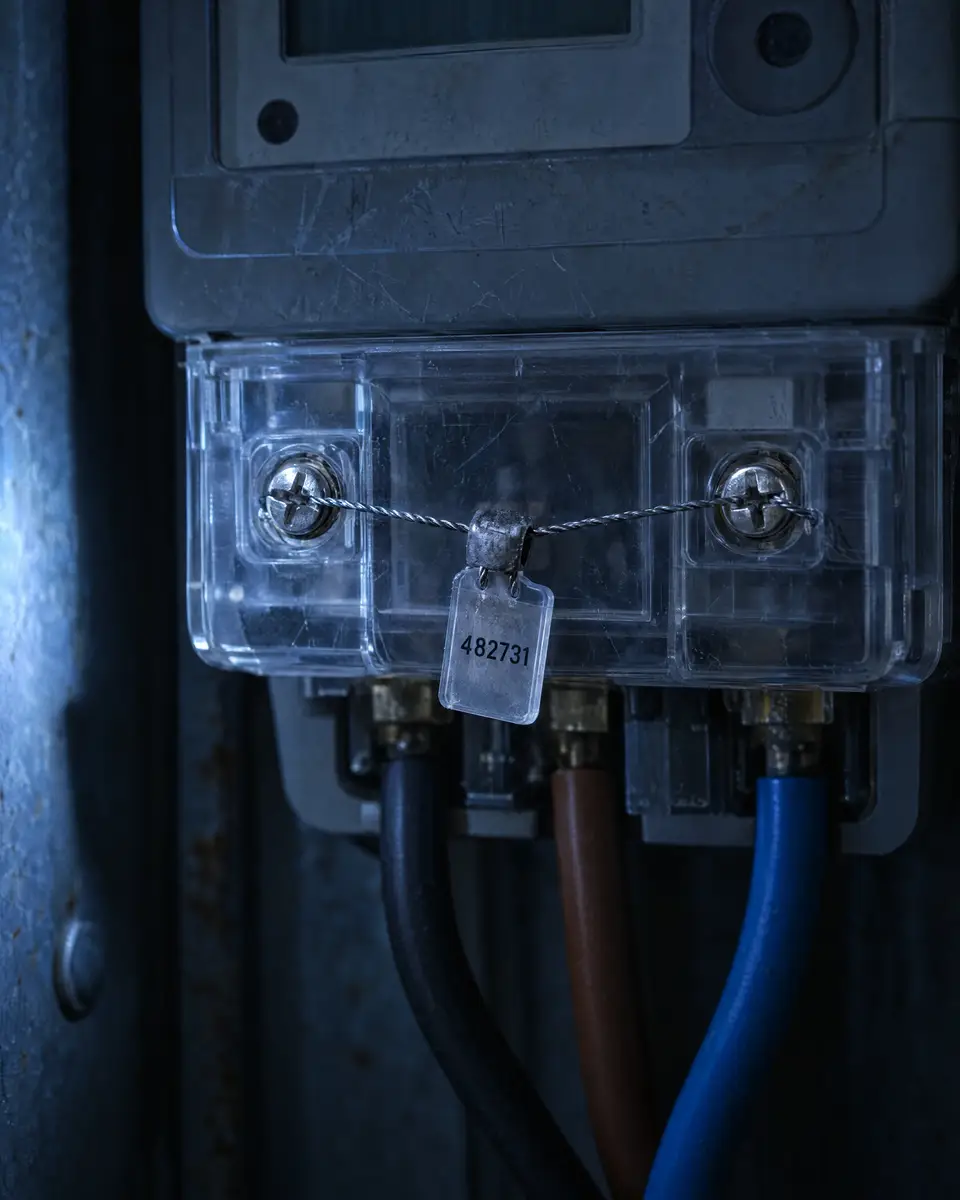
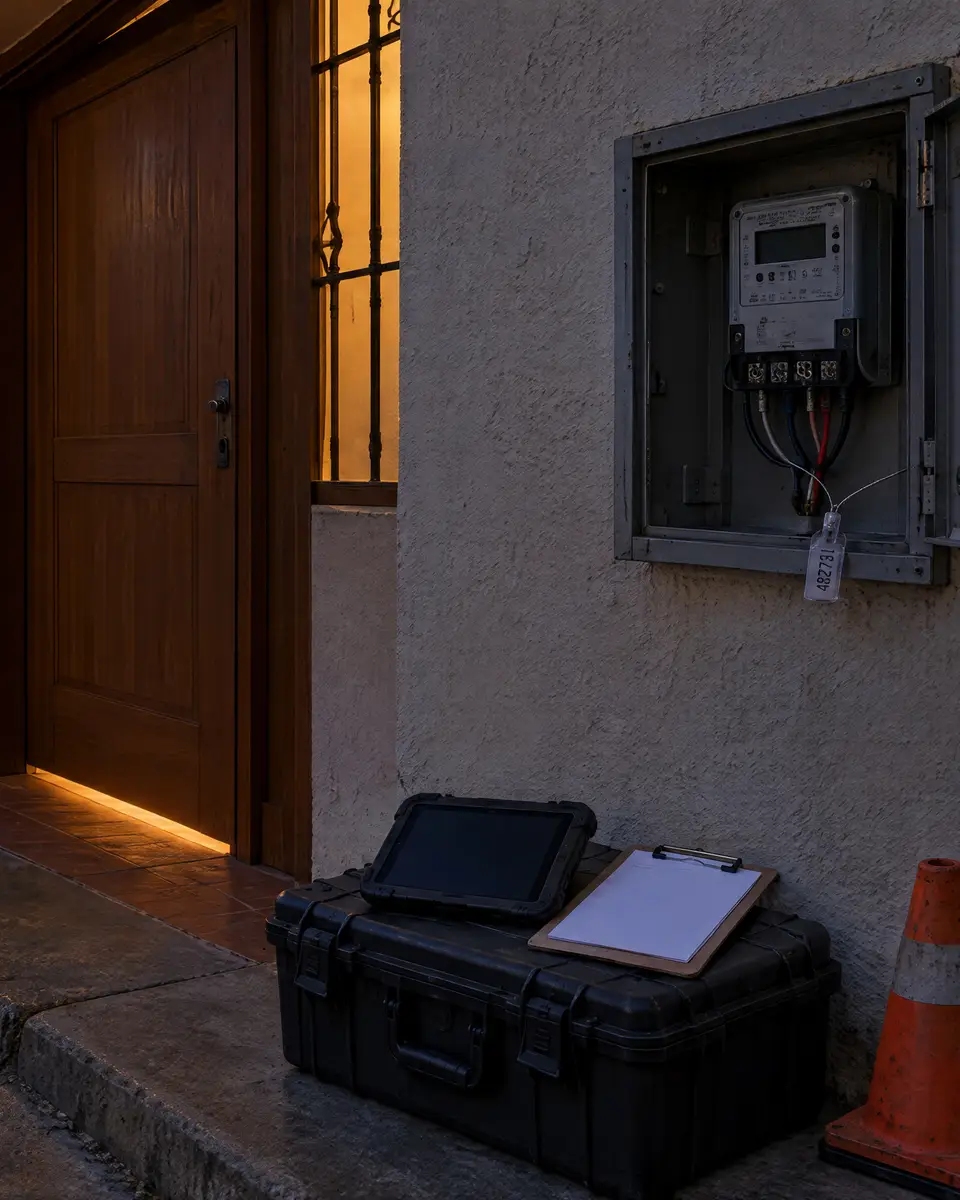
The record that does not reflect the meter.
How the false record is exposed
- What happens
- A tampered meter is written up as satisfactory, producing a falsified inspection report. Tampering is confirmed in the field, so detection is only as reliable as the visit itself (World Bank, 2009).
- Exposed by
- AI vision on key frames, checking seals, serial numbers and signs of manipulation.

The bribe at inspection.
How the bribe is exposed
- What happens
- A payment is offered to overlook a problem, and nobody from the utility is there to hear it. Theft by large consumers “usually involve[s] collusion between them and meter readers” (World Bank, 2009).
- Exposed by
- The transcribed audio, screened for bribery and threat language.
What if the inspector is part of the fraud?
The same evidence that documents the meter documents the visit.
How the evidence answers that
A visit closed without its evidence is scored for the gap. Footage access is limited by role and logged, and the audit log records each decision and role change, so the record shows who could alter the rules.
Sampling audits estimate the average. Full-population review examines every visit.
A sampling audit reviews a fraction of field visits after the fact. A visit that is not selected is not examined.
Visits reviewed120 of 120
Flagged and routed to a supervisor
- Reviewed by a sampling audit
- Reviewed by AI
- Flagged for a supervisor
- Take a month of field visits, as an example.
- A sampling audit reviews a few of them, after the fact.
- The bribe took place in a visit the audit did not select.
- Full-population review: AI examines every visit as it closes.
- The visit with the bribe is flagged and routed to a supervisor.
Compare sampling and full review
Sampling answers a fair question: roughly how common problems are across a population. Fraud is not a defect rate spread evenly across visits; it is an adversary choosing where to act, and under a sampling regime the rational choice is to play the odds.
| Comparison | Sampling audit | Full-population review with Fluyenta |
|---|---|---|
| Visits examined | A fraction, random or risk-based | Every visit in scope, as it closes |
| When review happens | After the work, when the visit is long closed | When the visit closes |
| What is reviewed | The written report | Sealed evidence |
| What a person reviews | Visits the audit plan selects, at random or by risk, most of them clean | Only the exceptions the score routes, with evidence attached |
| Effect on the adversary | The odds favor the fraud | The visit that avoids scrutiny is the visit that attracts it |
Organizations with proactive data monitoring recorded a median loss of USD 70,000 against USD 150,000 without it, and their schemes ran for 9 months rather than 16 (ACFE, 2026).
Six pieces of evidence, sealed into one record.
Together they form the evidence chain for one visit, recorded as the work happens.
Consent
Proves that recording began only after consent.
Video and audio
Proves what was shown and what was said.
GPS coordinates
Proves where the work took place.
Timestamps
Proves when each step happened, and in what order.
Digital signature
Proves that the work order was formally closed.
Seal
Proves whether anything has changed since sealing: any later change is detectable.
Evidence record
- Consent18:42:07
- Video and audio00:09:23
- GPS coordinates4.71101° N, 74.07217° W
- Timestamps18:42:07 to 18:51:30
- Digital signature18:51:30
Sealed9f3c 61ab 0e47 d2a8 5b19 c370
What each element records
An evidence chain is the linked set of proof generated by one piece of field work: recorded consent, video and audio, GPS coordinates, timestamps and a digital signature, sealed together with a cryptographic fingerprint so that any later alteration is detectable.
- Consent
- What is recorded. The customer’s consent, captured first.
- Video and audio
- What is recorded. The work as it happens, from a bodycam or mobile device.
- GPS coordinates
- What is recorded. The location of the visit, placing the work where it was reported.
- Timestamps
- What is recorded. The time of each milestone of the visit.
- Digital signature
- What is recorded. The signature that closes the work order.
- Seal
- What is recorded. A fingerprint computed over all of the evidence when capture ends. (NIST, 2015)
Evidence by construction
The proof is produced by doing the work: capture is part of the visit itself, with consent at the start, recording during and the signature at the close, so it replaces after-the-fact documentation rather than adding to it.
How the record holds up in a dispute about a technician visit
An evidence chain is not the same as a chain of custody, which records who handled evidence after it exists; the evidence chain generates the evidence in the first place. GPS, video and signatures give both parties a record to settle disputes about whether a visit happened, and it works as much in the technician’s favor as in the company’s. Whether the record is accepted in a formal dispute depends on your jurisdiction; confirm it with counsel.
How the fraud risk score works, and why it routes rather than decides.
Take one visit as an example: it closes, and its evidence enters review.
What was said.
This transcript contains an offer to overlook the problem, so the check flags it and the score rises to 74, into supervisor review.
What the camera saw.
Here the seal is intact and the serial number matches the paperwork, so this check passes and the score stays at 74.
Whether the recording was tampered with.
This recording has no long silences, muffling or sudden cuts, so it passes and the score holds.
Whether the evidence is present at all.
All six pieces of evidence are present, so the file is complete and the score holds at 74. A missing piece would have raised the score on its own.
Routed to a supervisor, with the evidence attached.
The AI chooses what a person looks at, never what happens to anyone.
Fraud risk score
74
- Flows through
- Supervisor review
- Blocked and escalated as a case
- What was saidFlagged
- What the camera sawPasses
- Whether the recording was tampered withPasses
- Whether the evidence is present at allComplete
Routed to supervisor review
- Reason: transcript flagged
- Evidence attached: all six pieces
What the score reads
Every visit in scope receives a fraud risk score from 0 to 100 when it closes. The score reads four signals across the six layers of evidence the visit produces.
What was said.
The audio is transcribed and screened for bribery and threat language.
What the camera saw.
Key frames are checked for intact seals, serial numbers that match the paperwork and signs of manipulation.
Whether the recording was tampered with.
Excessive silence, muffling and sudden cuts can each indicate tampering with the recording itself.
Whether the evidence is present at all.
A work order without its evidence does not close cleanly: the missing evidence is itself scored, and it raises the visit’s fraud risk score on its own.
Below the review threshold, the visit is approved and flows through. Between the review threshold and the critical threshold, a supervisor reviews it. Above the critical threshold, the work order is held and escalated as a case, with an urgent alert and the complete evidence chain attached.
Why the AI routes rather than decides
Routing means the score decides where the work order goes, not what happens to anyone. A low score lets the work order close without review. A middle score sends it to a supervisor. A score above the critical threshold holds the work order and escalates it as a case, so that a person decides what happens next. It is a human-in-the-loop design: a person who reviews the actual evidence decides on every flagged visit and on any action that concerns a person, and every AI action is logged. For context, Article 14 of the EU AI Act describes human oversight that can “disregard, override or reverse” an output (EU AI Act, Art. 14).
Your managers set the thresholds
Scoring weights, keywords and escalation thresholds are dashboard configuration that your own managers adjust without developers, so the utility decides how many visits reach a supervisor.
Start with one inspection type in one zone.
Governance and privacy, built into the record.
Fluyenta holds ISO/IEC 27001:2022 and ISO/IEC 27701:2019 certifications and is GDPR aligned.
Consent precedes capture.
Every field technician visit is recorded with the customer’s consent, captured at the start of the session.
Access is restricted by role.
Technicians, supervisors and administrators each see their own scope, and every access to footage is itself logged.
Every action is logged.
A complete audit log records every upload, analysis, decision and role change, giving auditors an AI audit trail of who changed what.
People take the consequential decisions.
The AI analyzes and recommends. Every flagged visit, and every action that affects a person, is decided by a person.
Evidence is protected.
Personal data is encrypted while it moves and while it is stored, systems are hosted in secure AWS data centers, and evidence is retained per policy and never silently deleted.
What it means for your technicians
Recording begins with the customer’s consent, and the AI does not accuse anyone: a flag sends a visit to a supervisor, who reviews it. The evidence protects the technician as much as the company, because it shows that the work was done.
- ISO/IEC 27001:2022Download certificate: ISO/IEC 27001:2022
- ISO/IEC 27701:2019Download certificate: ISO/IEC 27701:2019
Requirements for recording field visits vary by jurisdiction; confirm the rules for your country with counsel.

Designed for field conditions and the systems you already run.
Capture continues without signal.
The field service app is offline-first, built for remote areas. Recordings queue as encrypted uploads and resume automatically when connectivity returns.
Standard hardware that you own.
Standard Android devices and bodycams; the utility owns the hardware and Fluyenta licenses the software.
A fleet managed from a distance.
Devices pair with a PIN and receive over-the-air updates in staged rollouts, so the fleet stays current without being collected.
Around your existing systems.
Fluyenta connects to the systems a utility already runs rather than replacing them, through pre-built connectors, REST and SOAP interfaces, and secure gateway agents for on-premises systems. Which connections apply to your work-order, customer and asset systems is established by mapping them with Fluyenta’s integration team.
From pilot to rollout, one zone at a time.
Deployments start deliberately small: one inspection type in one zone, with the evidence chain and AI scoring applied there first, so the value can be quantified before scaling.
- Select the inspection
- Capture every visit
- Quantify the result
- Extend the rollout
What each phase involves
- Select the inspection
- One inspection type and the zone where you suspect the greatest risk.
- Capture every visit
- Every visit in the zone is recorded, sealed and scored.
- Quantify the result
- Measure what full-population review finds in that zone.
- Extend the rollout
- Add inspection types and zones once the value is established.
The terms in brief
- Contracting party
- AK Digital, LLC, which owns Fluyenta.
- License
- An annual fee set in an order form; the utility owns its devices and bodycams.
- Hosting
- AWS and DigitalOcean, as named in the Data Processing Agreement.
- Exit
- Up to 60 days to reclaim content after the agreement ends, then deletion unless retention is required by law.
Want this built and run for you? See how an AI consulting engagement works.
Questions from the decision committee, answered from published facts.
Does Fluyenta replace our work-order, customer or asset systems?
No. Fluyenta connects to your existing systems and does not replace them, and legacy workflow engines can be migrated one flow at a time rather than through a rewrite. The connections that apply are established by mapping your systems with Fluyenta’s integration team.
Who are we contracting with, and how does Fluyenta relate to RunMyProcess?
Fluyenta and RunMyProcess are two names for the same company, which is owned by AK Digital, LLC; client agreements are made with AK Digital, LLC. Fluyenta DigitalSuite is a new platform, technically distinct from RunMyProcess DigitalSuite.
What drives the cost of a deployment?
Fluyenta licenses the software and the utility owns the hardware, standard Android devices and bodycams. Under Fluyenta’s published Terms of Use, the platform is charged as an annual fee defined in an order form, within the usage metrics the client subscribes to. The review of every visit is performed by the platform, not by additional reviewers. The utility’s own costs sit alongside the license: its devices and bodycams, its supervisors’ time on flagged visits, which the thresholds it sets will govern, and any work to connect its existing systems.
What happens when a visit is wrongly flagged?
A flag routes the visit to a supervisor, who reviews the actual evidence; it is not a finding about a person. A person decides on every flagged visit, the decision is recorded in the audit log, and your managers set the thresholds that decide how many visits reach a supervisor.
What should we tell our technicians and their representatives?
That recording begins with the customer’s consent, that access to footage depends on role and is logged, and that the AI never accuses anyone: a flagged visit goes to a supervisor for review. The evidence also protects technicians: it shows the work was done, and it lets both sides settle a dispute over whether a visit happened.
Where is our footage stored, and who else processes it?
Systems run in AWS secure data centers and personal data is encrypted in transit and at rest. Fluyenta’s Data Processing Agreement lists Amazon Web Services, Inc. and DigitalOcean, LLC, in the United States, for hosting the platform, and the Trust Center names the other sub-processors and their purposes: Better Stack for log files, Zoho for support ticketing, Google for staff email, and Hyverr and PurpleTalk for second- and third-level support.
Can we audit Fluyenta?
Under the Data Processing Agreement, the client may verify compliance, including through inspections by designated auditors bound to confidentiality, and Fluyenta provides the relevant information and evidence on request.
What happens to our data if we end the agreement?
On expiry or termination, the Terms of Use give the client access for a maximum of 60 days to reclaim its content and applications. The Data Processing Agreement then provides that client data is deleted unless statutory retention obligations apply.
Know what happened on every field visit.
In production with field crews at a Colombian electric utility since July 2026. Certified to ISO/IEC 27001:2022 and ISO/IEC 27701:2019.
Further reading
Sources and notes
- Contrato CREG-UTP 082 de 2025, Informe final, Revisión 1 (opens in a new tab). Universidad Tecnológica de Pereira for the Comisión de Regulación de Energía y Gas (CREG), September 29, 2025 (pp.149 to 153).
- Documento CREG-901 194, Metodología de remuneración de la actividad de distribución de energía eléctrica (opens in a new tab). The same regulator (CREG), June 21, 2025 (pp.7 to 8).
- The economics of electricity losses in Latin America and the Caribbean (opens in a new tab). Inter-American Development Bank (Yépez García and Jiménez Mori), 2024 (pp.16, 32). CC BY 3.0 IGO.
- Occupational Fraud 2026: A Report to the Nations (opens in a new tab). Association of Certified Fraud Examiners, 2026 (pp.12, 18, 23, 40 to 41). Copyright 2026 by the Association of Certified Fraud Examiners, Inc.
- Reducing Technical and Non-Technical Losses in the Power Sector (opens in a new tab). World Bank (Antmann), July 2009 (pp.6, 25).
- ISA 530, Audit Sampling (opens in a new tab). IAASB (2012 Handbook), para. 5.
- FIPS 180-4, Secure Hash Standard (opens in a new tab). NIST, August 2015.
- Regulation (EU) 2024/1689 (EU AI Act), Article 14, Human oversight (opens in a new tab). Official Journal of the European Union, July 12, 2024.
Notes on scope
- The sampling grid and the score walkthrough on this page are worked examples, not customer data.
- The 14.95% and the Caribbean shares are weighted total losses (technical plus non-technical) across the markets with available data, from a consultancy study commissioned by the CREG (Contrato CREG-UTP 082 de 2025, pp.149 to 153). The CREG defines non-technical losses as those “produced basically by energy theft or by the absence of metering” (Documento CREG-901 194, 2025, pp.7 to 8; translated from the Spanish).
- The IDB figure combines technical and non-technical losses across Latin America and the Caribbean.
- The ACFE study covers occupational fraud in all industries and detected cases only. It is not a rate for field inspections, and the proactive-monitoring figures are an association, not a controlled comparison.
- The World Bank paper dates from 2009 and concerns large consumers.
- NIST states that any change to the data will produce a different digest “with a very high probability”.
- The EU AI Act is cited for context, not as a compliance claim.
- ISA 530 defines audit sampling as audit procedures applied to “less than 100% of items” in a population.