A woman in a white hard hat, safety glasses and a blue work jacket stands in a steel plant hall holding a technical drawing, with large metal coils beside her and the hall lights running off behind her.

Put AI to work in your operations and keep it working after go-live.

Enterprise AI consulting and implementation for large service operations and manufacturers. We find where your operations lose time, money or control, build the solution on the Fluyenta platform, and stay to run it with your team.

  • ISO/IEC 27001:2022 certified
  • ISO/IEC 27701:2019 certified
  • GDPR aligned
  • In production at a Colombian electric utility since July 2026

Updated November 11, 2026.

Many AI pilots stop at the demo They never reach the daily work.

Running a pilot is rarely the hard part. Connecting it to the systems, people and approvals that run the operation is, and that is where many projects stall.

The pattern is consistent: the model works, but nobody owns the integration, the change for the people who use it, or the job of keeping it right. A Fluyenta engagement is built around those three jobs.

How an engagement works Diagnose, build, then run it with you.

Three phases, one Fluyenta team from the first workshop to daily operation. The third phase has no end date: it keeps the solution useful as your operation changes.

Diagnose

Find where your operation loses time, money or control, and choose the first process to fix.

  • Map the process end to end, from request to closed record.
  • Measure where work waits, is re-keyed or goes unchecked.
  • Rank each problem by what it costs you.
  • Diagnostic reportYour current process mapped, with every problem ranked and the evidence behind it.
  • Success measureThe baseline today and the result that will prove the first process works.
  • RoadmapThe first process to fix, the ones that follow, and a dated plan for the build.

An executive sponsor, the process owner, two or three people who do the work every day, and an IT lead who knows your systems.
Your process, mapped. The highlighted steps are where work waits or is re-keyed.

Build

Build the solution on the Fluyenta platform, connected to your systems, and prove it on one process first.

  • Configure the workflow, the mobile steps and the AI steps.
  • Connect your ERP, work-order and document systems.
  • Test and approve every change before it reaches production.
  • Solution blueprintThe workflow, approval rules, roles and integrations, agreed before the build starts.
  • Live solutionThe first process running in production in one area, with trained users.
  • Measured resultThe first process compared with the baseline from the Diagnose phase.

The process owner signs off each step, your IT team grants access to the systems we connect, and the people who will use the solution test it before go-live.

Workflow, mobile app, AI steps and connectors, assembled on one platform.

Run

Stay involved after go-live, so the solution keeps improving as your operation changes.

  • Monitor the workflows, the AI steps and the integrations.
  • Review performance with you on a fixed schedule.
  • Train users and administrators, and ship tested improvements.
  • DashboardsWorkflow volume, bottlenecks and service levels, visible to your team.
  • Performance reviewsResults against the success measure, and a decision on what changes next.
  • SupportA named escalation chain, at the support level in your contract.

The executive sponsor and the process owner at each performance review, and your administrators, who learn to change workflows themselves.

Fluyenta stays involved after go-live, for as long as the solution runs.

  1. Monitor
  2. Review performance
  3. Train your team
  4. Improvethen the cycle repeats

What we build AI steps inside the work, not beside it.

Every solution runs on the Fluyenta platform: workflows, a mobile app for the field and the floor, governed AI steps, and connectors to the systems you have. These are the uses Fluyenta supports today.

For service operations

  • Evidence on every field visit.

    Consent, video and audio, GPS coordinates, timestamps and a digital signature are captured during the visit and sealed into one record, so a supervisor can check what happened.

    How field evidence works
  • AI review of every visit.

    Each visit gets a risk score from the evidence, and a person reviews the ones that need it, instead of sampling a few at random.

    How visits are reviewed
  • Work orders that close with proof.

    A work order closes with a digital signature and the evidence attached; one without evidence does not close cleanly.

  • Field work without signal.

    The mobile app is offline-first: capture continues without coverage and uploads resume when the signal returns.

  • Paperwork read by AI.

    Document AI reads scanned documents and tables, classifies them, extracts the fields and checks them for compliance, then hands them to the next step.

For manufacturing

  • Predictive maintenance.

    Sensor and equipment signals trigger maintenance work before a failure stops the line.

  • Quality control.

    Inspection results are recorded at each step, and a person decides what happens to a deviation.

  • Work orders and equipment tracking.

    Maintenance work orders and each asset’s history live in one record.

  • Production scheduling.

    Production schedules are planned around the resources available.

  • Shift handover and safety compliance.

    What happened on a shift, and every safety check, is recorded and passed on.

  • Supplier and raw materials intake.

    Supplier records and incoming materials follow one governed workflow before they reach production.

Each one is a configured workflow on the platform, connected to your systems. The Diagnose phase decides which comes first.

Who we work with Large operations teams with work in the field or on the floor.

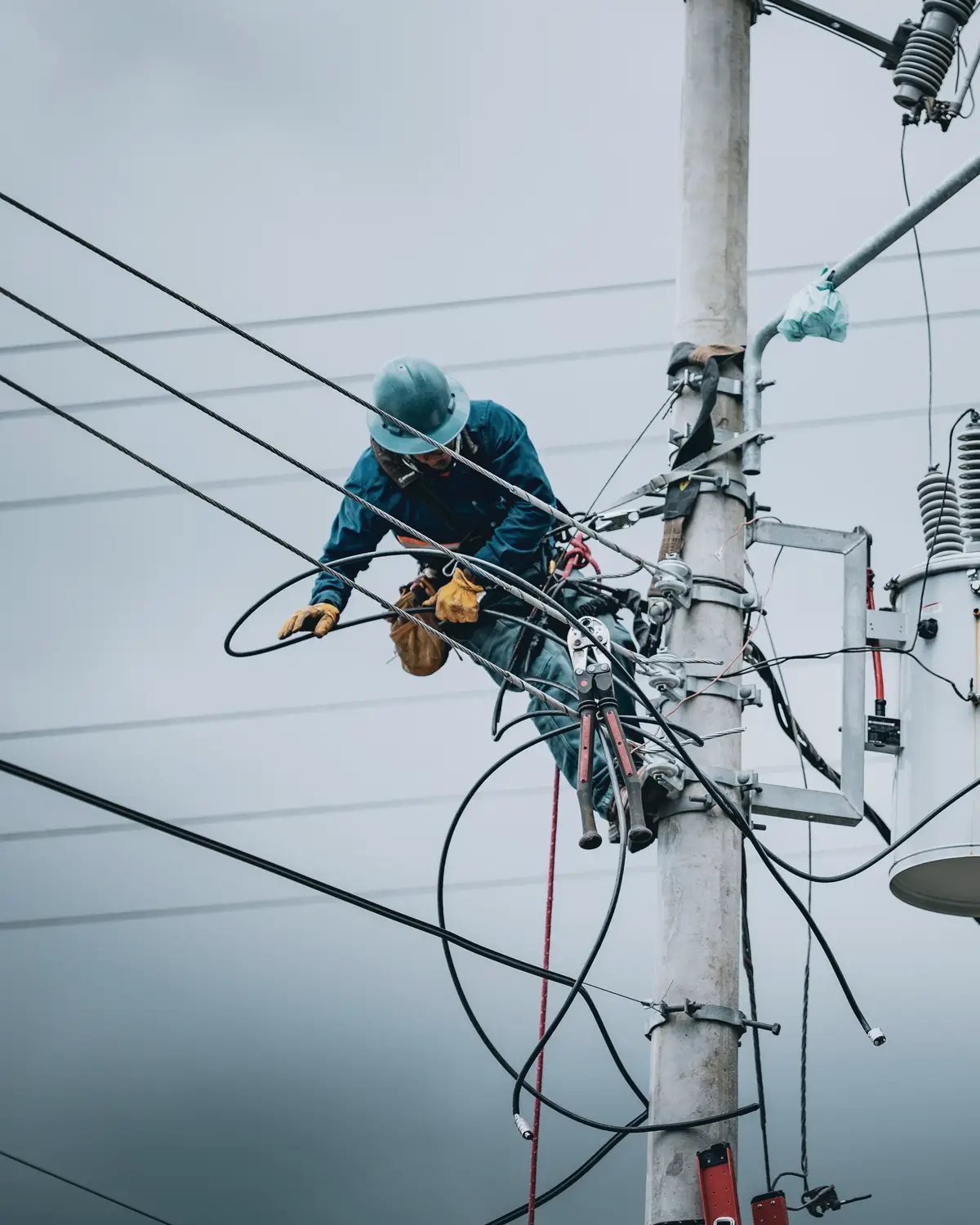
A utility lineman in a hard hat and harness works on cables at the top of a power pole under a gray sky.

Large service operations

Utilities, field service companies and facilities teams with crews spread across sites.

Problems, uses and outcomes
Problems
Visits that cannot be verified after the fact. Reports re-typed from paper into several systems. Approvals that wait in email. Crews who work where there is no signal.
What we build
Evidence on every visit, AI review of every visit, work orders that close with proof, offline field capture, document AI for the paperwork.
Outcomes you can measure
Every visit leaves a record a supervisor can check. Reviews cover every visit, not a sample. Approvals reach the right person and are logged. Office staff stop re-keying field reports.
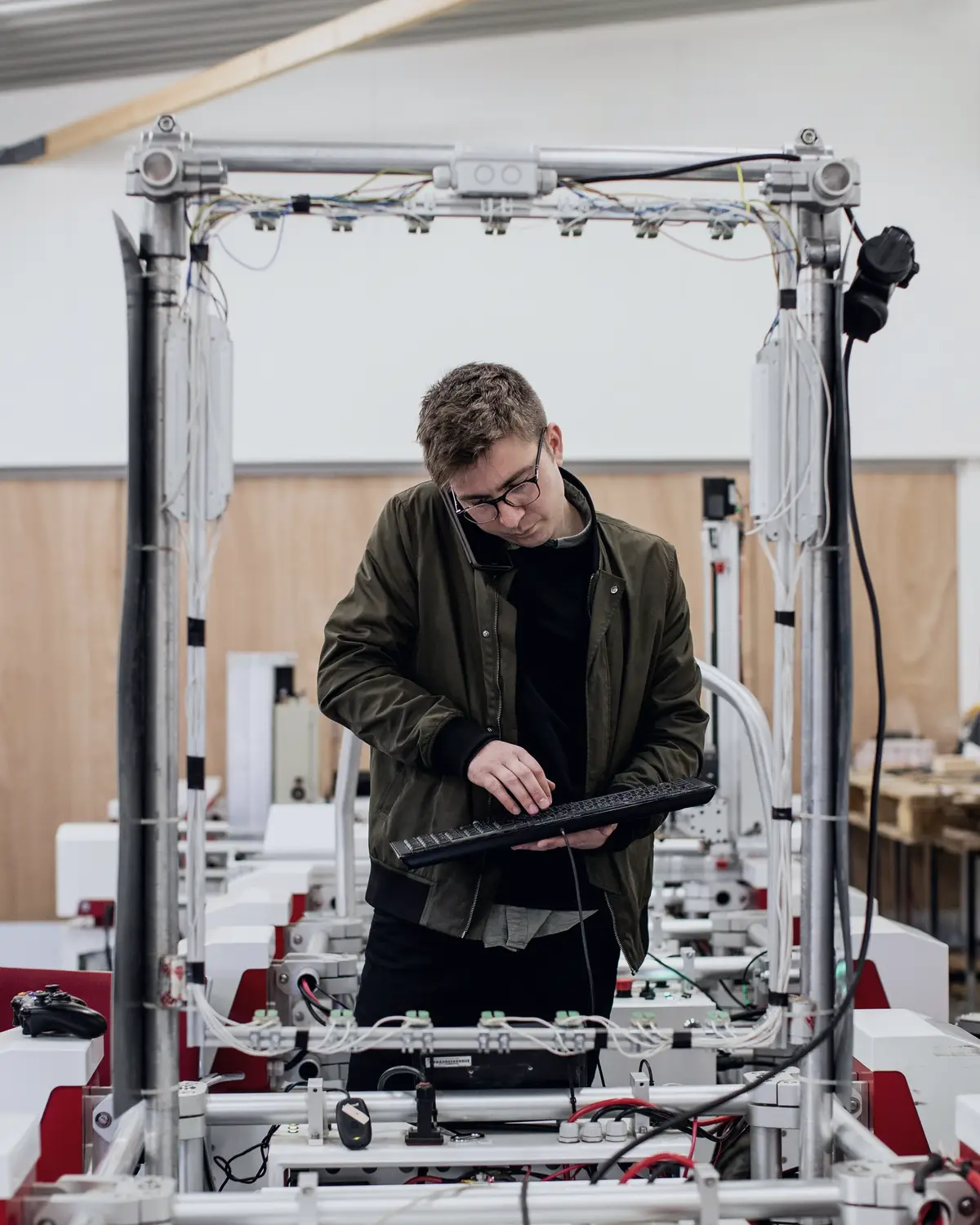
An engineer in glasses and an olive jacket checks a test rig on a production floor, holding a keyboard.

Manufacturers

Plants and supply chains where downtime, quality and paperwork set the margin.

Problems, uses and outcomes
Problems
Equipment that fails without warning. Quality records kept on paper or in spreadsheets. Shift handovers that lose information. Supplier documents checked by hand.
What we build
Predictive maintenance, quality control workflows, maintenance work orders and equipment tracking, production scheduling, shift handover, supplier and raw materials intake.
Outcomes you can measure
Maintenance is planned before a failure, not after it. Every quality check is recorded and traceable. Each shift starts with what the last one knew. Incoming materials are checked before they reach the line.

After go-live We stay, and the solution keeps improving.

Go-live is the start of the part that decides whether the investment pays. This is where many AI projects lose their owner. In a Fluyenta engagement, the same team stays on it.

  • Monitoring.

    Dashboards track workflows, bottlenecks, service levels and task ownership, and alerts reach the right people before a problem grows.

  • Performance reviews.

    On a fixed schedule, we review the success measure from the Diagnose phase with your process owner and decide what changes next.

  • Training.

    Users learn the new steps before go-live; your administrators learn to build and change workflows themselves, so you do not depend on us for every change.

  • Improvement cycles.

    Changes are versioned, tested and approved before they reach production, and can be rolled back.

  • Support.

    Tickets go through a named support chain with second- and third-level support behind it, under a monthly availability commitment of 99.9% in the Terms of Use.

The next process is cheaper than the first: the platform, the integrations and the trained team are already in place.

Security and certifications Audited controls, governed AI.

Every certificate below is published in full on the Fluyenta Trust Center, where your security team can download it.

Open the Trust Center

Governed AI

  • A person makes every consequential decision.

    AI steps score, sort and draft; approvals and overrides sit with a person at each decision point.

  • Every AI action is logged.

    Each upload, analysis, decision and role change lands in the audit trail, available to auditors on demand.

  • Access is restricted by role.

    Permissions are granted by role, team and organizational unit, with least privilege enforced by the platform.

  • Only approved models.

    AI steps use models from one catalog your organization has cleared, with guardrails on every agent action.

Data protection

  • Personal data is encrypted in transit and at rest.
  • Systems run in AWS secure data centers; where your data is hosted is agreed during deployment.
  • Breach notification within 72 hours (Data Processing Agreement, clause 11.3).
  • 60 days to retrieve your data after the contract ends (Terms of Use, clause 13).
  • Seven named sub-processors, listed in Annex 1 of the Data Processing Agreement.

In production A Colombian electric utility, since July 2026.

Fluyenta’s offline-first field capture, evidence chain and AI scoring run in production with real field crews at a Colombian electric utility, live since July 2026.

  • What runs: field crews capture evidence on every visit with the mobile app, including where there is no signal; each visit is scored by AI; supervisors review the visits that need it.
  • Who decides: every consequential decision is gated by a person, and every AI action is logged.
See the field evidence model

What drives the cost Six factors set the price of an engagement.

There is no fixed price list for consulting. The Diagnose phase ends with a scoped plan and a price based on these factors.

  • Scope.

    How much of the operation the engagement covers: one process in one area, or several across the company.

  • Number of processes.

    Each process is mapped, built, tested and trained separately.

  • Integrations.

    Each system to connect (ERP, work orders, documents, sensors) adds build and testing work. Pre-built connectors cost less than custom ones.

  • Data volume.

    The number of visits, records, documents and AI steps the solution handles each month.

  • Deployment regions.

    Each country or region adds languages, data residency choices and local rules.

  • Support level.

    How much monitoring, review and training continues after go-live.

Book a discovery session to scope the first process.

Questions from buying committees What leaders ask before they start.

What does an AI consulting engagement with Fluyenta include?

It covers three phases. Diagnose maps where an operation loses time, money or control and picks the first process. Build configures the solution on the Fluyenta platform and connects it to your systems. Run keeps Fluyenta involved after go-live with monitoring, performance reviews, training, improvements and support.

Does Fluyenta integrate with our ERP and work-order systems?

Yes, through pre-built connectors for systems such as SAP, Microsoft Dynamics 365, Salesforce and Workday, REST and SOAP APIs, and secure gateway agents for systems behind a firewall. Where no connector exists, the integration team builds a custom one. The approach is system-agnostic, so legacy and cloud systems can both be connected.

How soon do we see a first result?

The Build phase starts with one process in one area, so the result can be measured before the solution is scaled. The Diagnose phase sets the success measure and the date. How long it takes depends on the number of systems to connect and how much the process varies between sites.

Why do so many AI pilots never reach production?

Many pilots prove that a model works but leave out the work around it: connecting it to the systems of record, deciding who approves its output, training the people who use it, and keeping it accurate once it runs. An engagement plans those jobs from the Diagnose phase onward.

Who owns the solution and our data?

Fluyenta licenses the platform software. Your data can be retrieved for 60 days after the contract ends, under clause 13 of the Terms of Use, and Fluyenta’s handling of personal data is set out in the Data Processing Agreement. Ownership of the workflows configured for you is agreed in the contract.

What happens after the engagement ends?

The Run phase has no fixed end: it continues for as long as the solution is in use, at the support level agreed in the contract. Your administrators are trained to change workflows themselves, so the solution does not depend on Fluyenta for every change.

What is the difference between AI consulting and managed AI services?

AI consulting decides what to build and how; managed AI services keep it running afterwards. A Fluyenta engagement does both: the Diagnose and Build phases are the consulting part, and the Run phase is the managed service.

How is the AI governed and audited?

A person approves every consequential decision, every AI action is logged in the audit trail, access is granted by role with least privilege, and AI steps use only models from an approved catalog. Changes to workflows are tested and approved before they reach production.

Which security certifications does Fluyenta hold?

Fluyenta holds ISO/IEC 27001:2022 and ISO/IEC 27701:2019 certifications, both downloadable from the Trust Center, and is GDPR aligned. GDPR has no certificate of its own: the ISO/IEC 27701 certificate and the Data Processing Agreement are the evidence. Fluyenta does not hold ISO/IEC 42001, the AI management system standard.

How do you get staff to use the new solution?

Workflows are modeled on how your teams already work, the people who will use them test them before go-live, and users are trained on the new steps. Field crews use a mobile app that keeps working without signal, so the new process does not depend on coverage.

Start with one process. Keep the team that built it.

A discovery session is a first conversation about your operation: where it loses time, money or control, and whether an engagement makes sense.

  • In production at a Colombian electric utility since July 2026

Sources and notes

  1. Deloitte, "From Ambition to Activation: Organizations Stand at the Untapped Edge of AI's Potential" (State of AI in the Enterprise 2026) (opens in a new tab), press release, January 21, 2026. Survey of 3,235 business and IT leaders in 24 countries, August to September 2025.
  2. Deloitte, "AI in Manufacturing 2026: From pilot value to scaled industrial impact" (opens in a new tab), June 30, 2026. Survey of 140+ manufacturers.
  3. Gartner, "Gartner Survey Finds Only 13% of CIOs Say Their Enterprise Has Realized Significant or Transformational Value from AI" (opens in a new tab), press release, October 19, 2026. Survey of 2,002 CIOs and technology executives, May to July 2026.

Notes on scope

  • Fluyenta facts: Trust Center (certificates, contract commitments, sub-processors); Professional Services (strategy to long-term managed delivery); Capabilities and Governance and security (human in control, audit trail, role-based access, release control); Manufacturing use cases; Integrations; the offline-first answer page (Colombian deployment, July 2026).
  • GDPR has no certificate of its own; Fluyenta’s evidence is the ISO/IEC 27701:2019 certificate and the Data Processing Agreement (Art. 28 GDPR). Visuals on this page are schematic.